Transformer Oil Lab Testing: The Early Warning System for Your Power Grid
Your transformer’s oil is more than just a coolant; it is a diagnostic liquid that carries vital information about the internal health of your equipment. Transformer Oil Laboratory Testing is the most cost-effective way to prevent catastrophic failures and extend the life of your critical assets. We provide precise, data-driven analysis to help you move from reactive repairs to a proactive maintenance strategy.
Why Test Transformer Oil?
Over time, electrical and thermal stresses break down the chemical structure of insulating oil. If left unchecked, this degradation leads to sludge formation, insulation failure, and eventually, a total transformer blowout.
- Detect Hidden Faults: Identify internal arcing or overheating before they cause a shutdown.
- Prevent Acidic Corrosion: Monitor acidity levels that can eat away at the transformer's copper and paper insulation.
- Optimize Maintenance Costs: Only perform oil filtration or replacement when the data proves it is necessary.
1. Dissolved Gas Analysis (DGA)
Often called the "Blood Test" for transformers, DGA measures the concentrations of specific gases (like Hydrogen, Methane, and Acetylene) dissolved in the oil. This allows us to diagnose:
- Partial Discharge (Corona)
- Overheating of cellulose or oil
- High-energy arcing
2. Dielectric Strength (BDV Test)
We measure the voltage at which the oil electrically breaks down. This determines the oil's ability to withstand electrical stress without failing.
3. Physicochemical Analysis
We perform a battery of tests to assess the physical "fitness" of the fluid:
- Moisture Content (Karl Fischer): High water content is the #1 enemy of insulation.
- Acidity/Neutralization Number: High acidity indicates oil oxidation and aging.
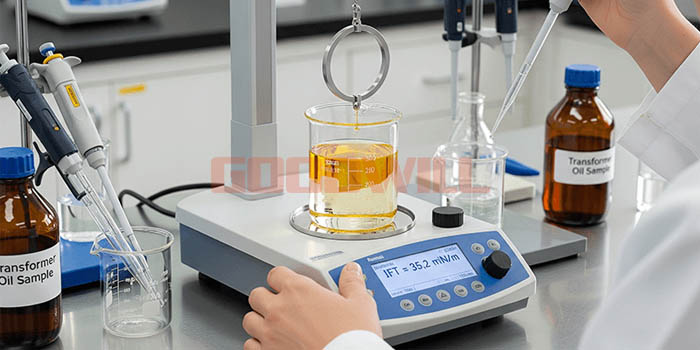
- Interfacial Tension (IFT): Detects the presence of sludge and soluble contaminants.
4. Furan Analysis
By measuring furanic compounds, we can estimate the remaining life of the internal paper insulation without ever opening the transformer.
Detailed Reporting & Interpretation
We don’t just send you a spreadsheet of numbers. Every sample processed in lab comes with:
- Trend Analysis: Comparing current results with historical data to spot developing patterns.
- Severity Rating: Clear "Normal," "Caution," or "Critical" status indicators.
- Expert Recommendations: Actionable advice on whether to filter, degas, or replace the oil.

Get full range
of premium services